
Fiduciary Duty for Condominium Boards: Why Financial Decisions Must Reflect Building Reality
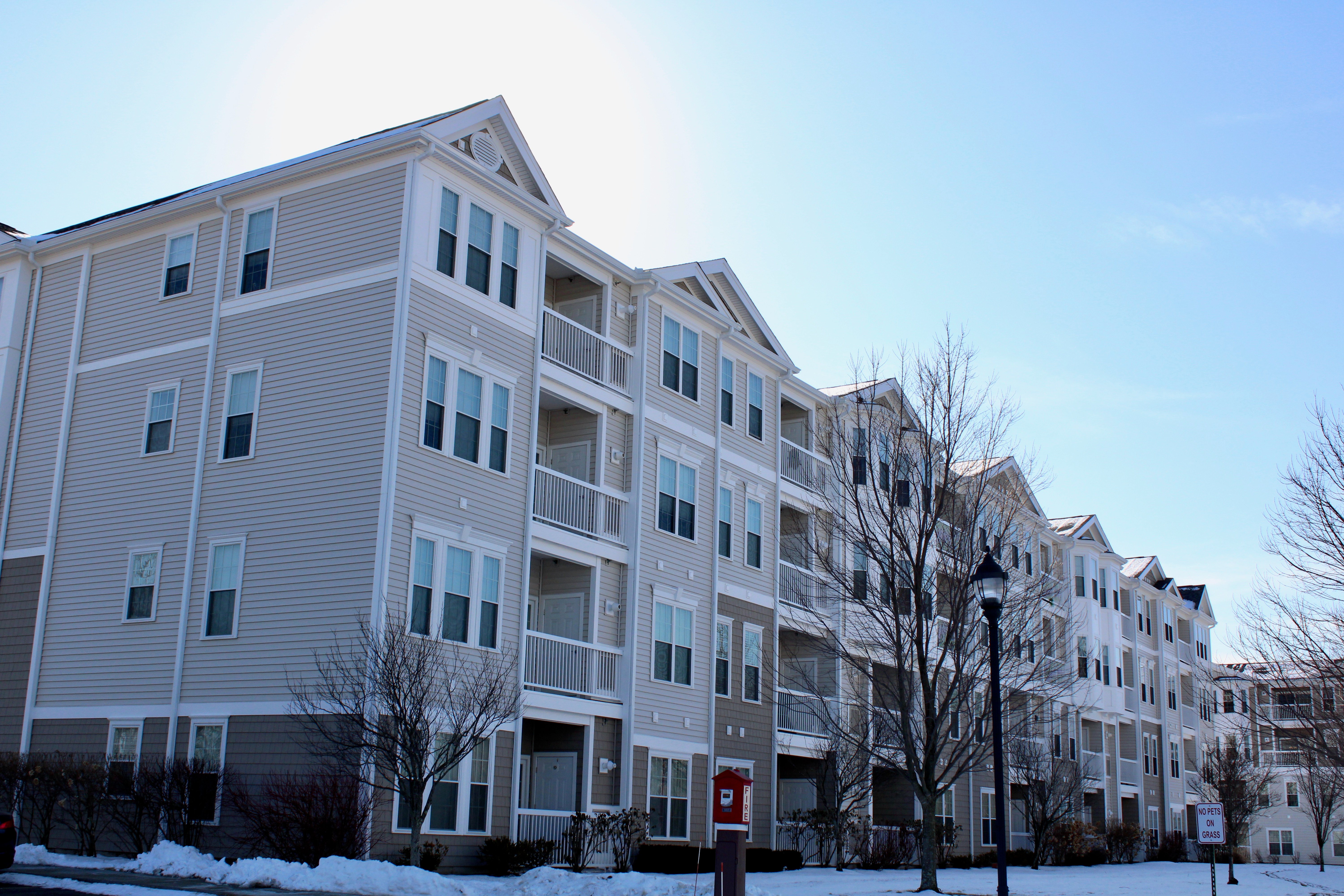
Condominium boards have always been responsible for making decisions that protect their communities. Today, however, those responsibilities are receiving greater attention than ever before.
Reserve funding expectations are changing. Insurance carriers are taking a closer look at building conditions. Lending requirements continue to evolve. At the same time, homeowners increasingly expect transparency about the financial health of their communities and the condition of the buildings they call home.
These changes have elevated the importance of fiduciary duty.
While fiduciary responsibility has always required boards to act in the best interests of the association, today's environment demands that those decisions be supported by sound financial planning, reliable technical information, and a clear understanding of the community's long-term needs. Decisions based primarily on keeping fees low or postponing difficult projects may create greater financial and legal challenges in the future.
Understanding fiduciary duty is no longer simply a governance issue. It is a leadership issue that affects building performance, reserve funding, property values, homeowner confidence, and the long-term sustainability of the community.
This article explores what fiduciary duty means in practice, why it is becoming increasingly important, and how condominium boards can make decisions that better protect both their communities and themselves.
Key Takeaways
- Fiduciary duty requires boards to act in the best interests of the association as a whole.
- Financial decisions should be based on building conditions rather than short-term financial pressures.
- Deferred maintenance often increases future repair costs, financial risk, and operational challenges.
- Reserve funding, transparency, and long-term planning work together to support healthier communities.
- Strong leadership combines technical information, financial planning, and clear communication.
What Fiduciary Duty Really Means
The phrase fiduciary duty is frequently used in condominium governance, but its practical meaning is often misunderstood.
Many people assume fiduciary responsibility simply means managing association finances responsibly or complying with governing documents. While those responsibilities are important, fiduciary duty extends much further.
At its core, fiduciary duty requires board members to make decisions that serve the best interests of the entire condominium association—not individual homeowners, not individual board members, and not short-term political interests. Every significant decision should be evaluated based on how it affects the long-term health of the community as a whole.
That perspective becomes especially important when communities face expensive capital projects, reserve funding challenges, or difficult maintenance decisions.
The Community Comes First
Serving on a condominium board requires balancing many competing priorities.
Homeowners may prefer lower monthly fees. Some residents may advocate delaying projects that appear expensive or inconvenient. Others may focus on concerns that affect only a small portion of the community.
Fiduciary duty requires boards to step back from those individual interests and ask a different question:
What decision best protects the long-term interests of the entire association?
That shift in perspective changes how boards evaluate major projects, reserve contributions, and maintenance priorities.
Rather than viewing repairs solely as expenses, boards begin viewing them as investments in the safety, functionality, and long-term value of the community.
Fiduciary Responsibility Requires Long-Term Thinking
Many of the decisions condominium boards make today will affect owners years into the future.
A roof replacement deferred today may result in interior water damage several years later. Delaying building envelope repairs may increase deterioration that eventually requires more extensive restoration. Underfunding reserves today may leave future boards with limited options when major projects become unavoidable.
Because buildings continue to age regardless of annual budgets, fiduciary responsibility requires boards to think beyond the current fiscal year.
Effective leadership considers not only today's financial position, but also the future condition of the community's physical assets and the financial resources needed to maintain them responsibly.
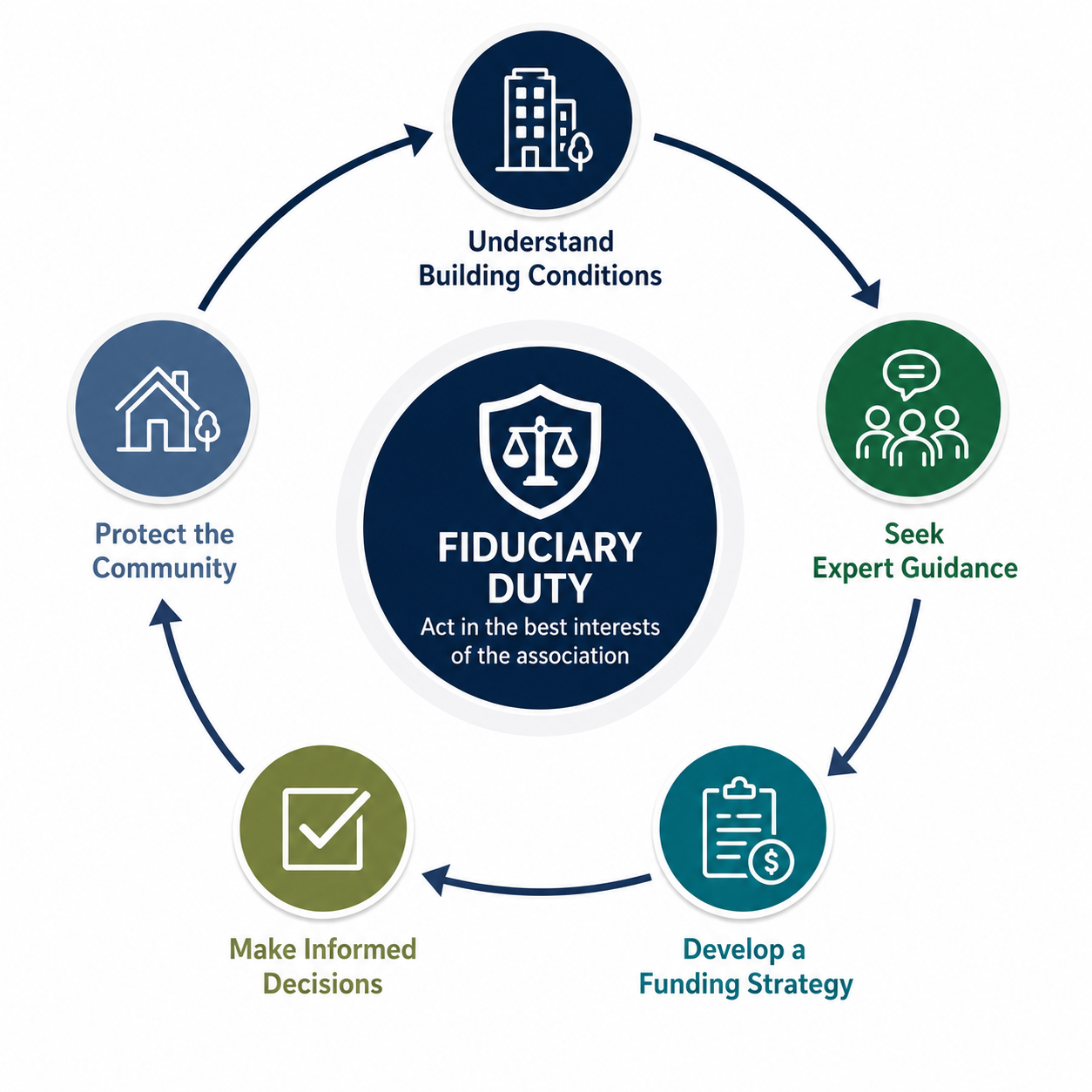
Leadership and Fiduciary Duty Go Hand in Hand
While fiduciary duty is often discussed as a legal obligation, it is equally a leadership responsibility.
Strong leadership means making decisions that may not always be the easiest or the most popular, but that are necessary to protect the long-term interests of the community.
Effective board leadership also depends on how board members communicate, collaborate, and work through difficult decisions together. Building consensus around complex financial and maintenance issues is often just as important as the technical decisions themselves. For more on strengthening board collaboration, explore our article, From Gridlock to Consensus: Applying the Five Dysfunctions of a Team to Your HOA Board.
In many condominium associations, financial limitations create pressure to postpone projects, reduce reserve contributions, or prioritize short-term affordability over long-term planning.
Those pressures are understandable.
However, the amount of money currently available should not determine whether an important maintenance issue exists. The building's condition determines the need. Funding strategies should then be developed to address that need responsibly.
Separating building needs from current financial constraints creates a healthier decision-making process.
Instead of asking, "Can we afford to do this?", boards first ask, "What does the building actually need?"
Only after understanding the technical reality should the discussion shift toward reserve funding, assessments, financing options, or project timing.
This approach allows communities to make decisions based on facts rather than financial pressure alone.
Facts Should Drive Financial Decisions
Complex building systems require informed decision-making.
Few volunteer board members have professional experience in building envelope science, structural engineering, reserve planning, or large-scale restoration. Recognizing those limitations is not a weakness—it is part of responsible governance.
Seeking guidance from qualified professionals helps boards understand existing building conditions, prioritize repairs, estimate future costs, and develop realistic long-term funding strategies. Technical expertise provides the factual foundation that allows financial decisions to be made with greater confidence and transparency.
Why Deferred Maintenance Is More Than a Maintenance Issue
One of the most significant misconceptions in condominium management is that delaying a repair simply postpones an expense.
In reality, deferred maintenance often increases the total cost of ownership while introducing additional financial, operational, and legal risks.
Every building component has a predictable lifecycle. Roofs, siding, windows, balconies, waterproofing systems, pavement, and other common elements naturally deteriorate over time. When maintenance or replacement is delayed beyond the appropriate point, deterioration rarely remains isolated to the original problem.
Instead, one issue frequently creates several new ones.
A leaking roof may eventually damage insulation, framing, drywall, and interior finishes. Failed sealants around windows may allow moisture into the wall assembly. Small drainage issues can develop into structural repairs that are significantly more expensive than addressing the original condition.
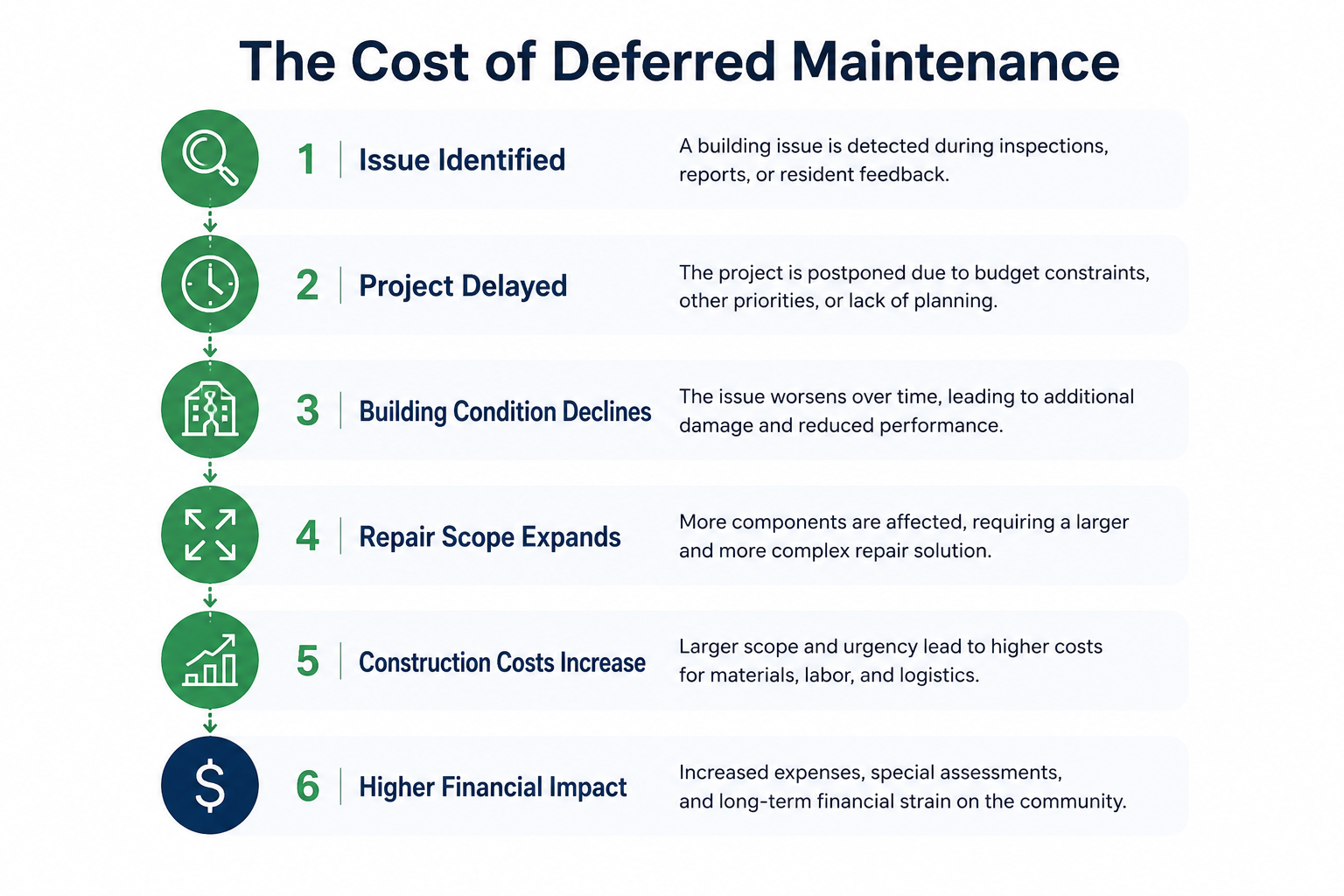
Deferred maintenance is not simply postponing a project—it often allows the scope of work to grow.
The Cost of Waiting Continues to Grow
Even when a repair appears manageable today, delaying action can increase costs in several ways.
Construction costs continue to rise over time due to inflation, labor availability, and material pricing. At the same time, the physical condition of the building continues to decline.
This creates a compounding effect.
The longer necessary work is postponed, the more likely the community will face:
- Larger repair scopes
- More extensive deterioration
- Higher construction costs
- Increased disruption to residents
- Greater financial pressure when repairs can no longer be delayed
In many cases, communities delay projects because funding is limited. Unfortunately, waiting often creates an even larger funding challenge later. The project becomes more expensive while reserve balances may still be insufficient to cover the increased cost.
Deferred Maintenance Can Affect More Than the Building
The consequences of deferred maintenance extend beyond repair costs.
Poorly maintained communities may experience:
- Reduced buyer confidence
- More issues identified during home inspections
- Greater difficulty obtaining competitive insurance coverage
- Increased scrutiny from lenders
- Lower long-term property values
In other words, building conditions influence much more than maintenance budgets. They affect the overall financial health and marketability of the community.
Protecting the physical condition of the property is also a way of protecting homeowners' long-term investment.
Reserve Funding Should Support Long-Term Planning
Reserve funding is often discussed as a financial requirement, but its purpose is much broader.
A well-funded reserve account allows communities to respond to known capital expenses without relying entirely on special assessments or emergency financing.
More importantly, reserve funding supports proactive decision-making.
When boards understand future building needs and develop a funding strategy in advance, they gain greater flexibility to plan projects at the appropriate time rather than waiting until conditions become critical.
Reserve funding should therefore be viewed as part of a long-term planning process—not simply an accounting exercise.
Every Community Has Different Funding Needs
One of the recurring themes throughout the webinar was that there is no universal reserve funding percentage that defines a financially healthy condominium association.
Every community has different buildings, different infrastructure, different maintenance histories, and different future capital needs.
For that reason, reserve funding should be based on the specific needs of the community rather than a single benchmark or rule of thumb.
A newer condominium with relatively few upcoming capital projects may require a different funding strategy than an older community preparing for multiple major restoration projects.
The goal is not simply to accumulate reserves.
The goal is to ensure the community has a realistic plan for funding future obligations while maintaining financial flexibility.
Reserve Studies Help Boards Plan Ahead
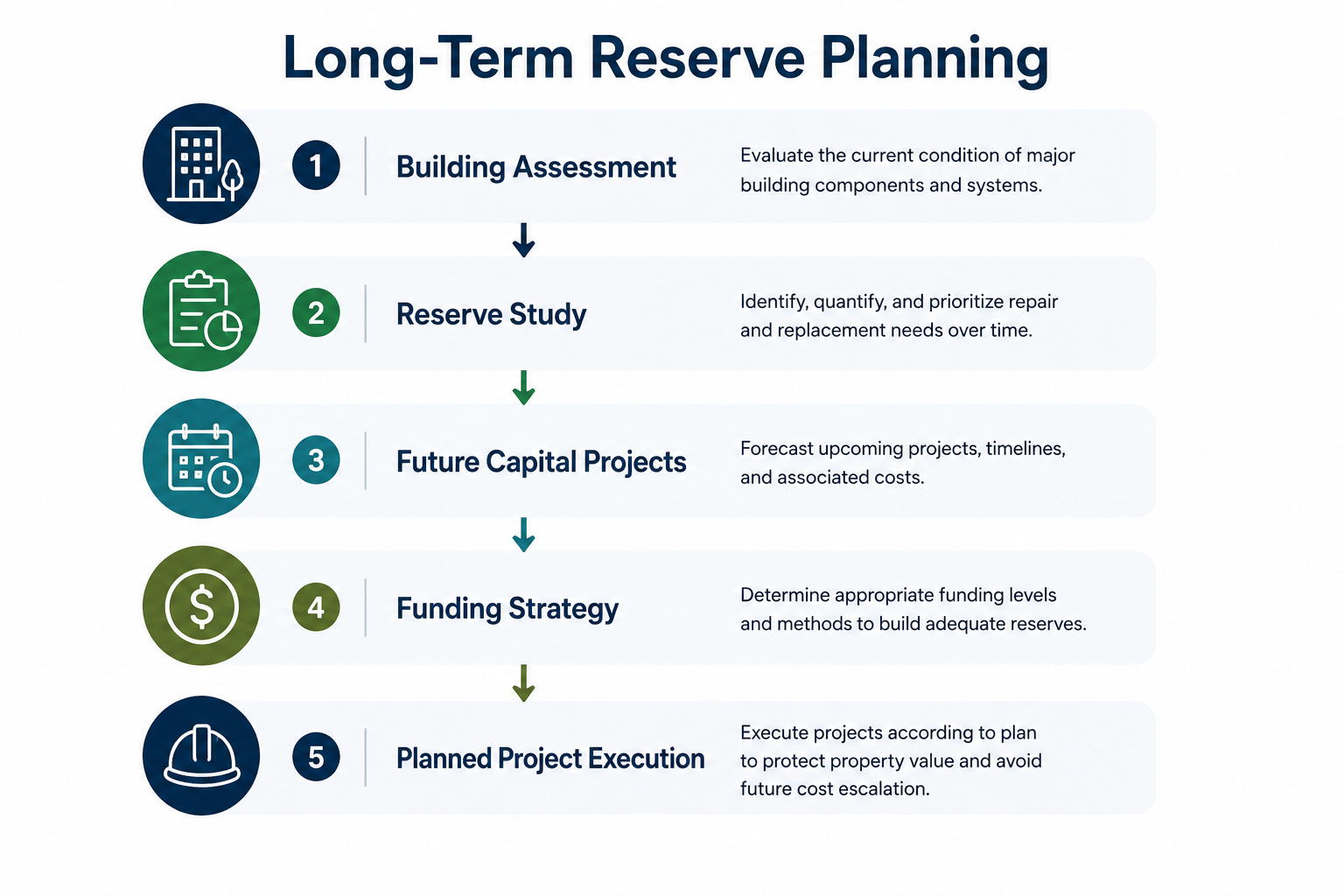
Reserve studies play an important role in helping boards understand future capital expenditures.
Rather than reacting to projects as they arise, reserve studies provide a structured framework for anticipating major repairs and replacements over time.
Combined with building condition assessments and professional guidance, reserve studies help boards answer important questions such as:
- What projects are expected over the next several years?
- When are those projects likely to occur?
- Approximately how much funding will be required?
- How should reserve contributions evolve over time?
Answering these questions early allows communities to make more informed financial decisions and reduces the likelihood of unexpected funding challenges.
Financial Decisions Should Follow Building Conditions
One of the strongest ideas discussed throughout the webinar was that building conditions—not current financial limitations—should determine what work needs to be done.
Too often, communities begin with the question:
"What can we afford?"
While understandable, that approach can unintentionally shift attention away from the building itself.
A more effective decision-making process begins with understanding the actual condition of the property.
Once those conditions are known, boards can evaluate available funding options, adjust reserve contributions, consider financing, phase projects where appropriate, or explore other financial strategies.
Separating technical needs from financial planning creates a healthier governance process because it ensures that important maintenance decisions are based on facts rather than immediate budget pressures.
Professional Expertise Strengthens Better Decisions
Most condominium board members serve as volunteers.
They bring valuable leadership experience, but few have professional backgrounds in structural engineering, building envelope science, reserve planning, construction, insurance, or capital project management.
Recognizing those limitations is an important part of effective governance.
Seeking guidance from qualified professionals allows boards to better understand existing building conditions, evaluate future risks, estimate project costs, and prioritize repairs based on objective information rather than assumptions.
That collaborative approach helps boards make decisions with greater confidence while providing homeowners with a clearer understanding of why those decisions are being made.
Building Conditions Influence More Than Maintenance Costs
When communities think about maintenance decisions, the discussion often centers on project costs and reserve balances.
In reality, the condition of a condominium community affects much more than its maintenance budget.
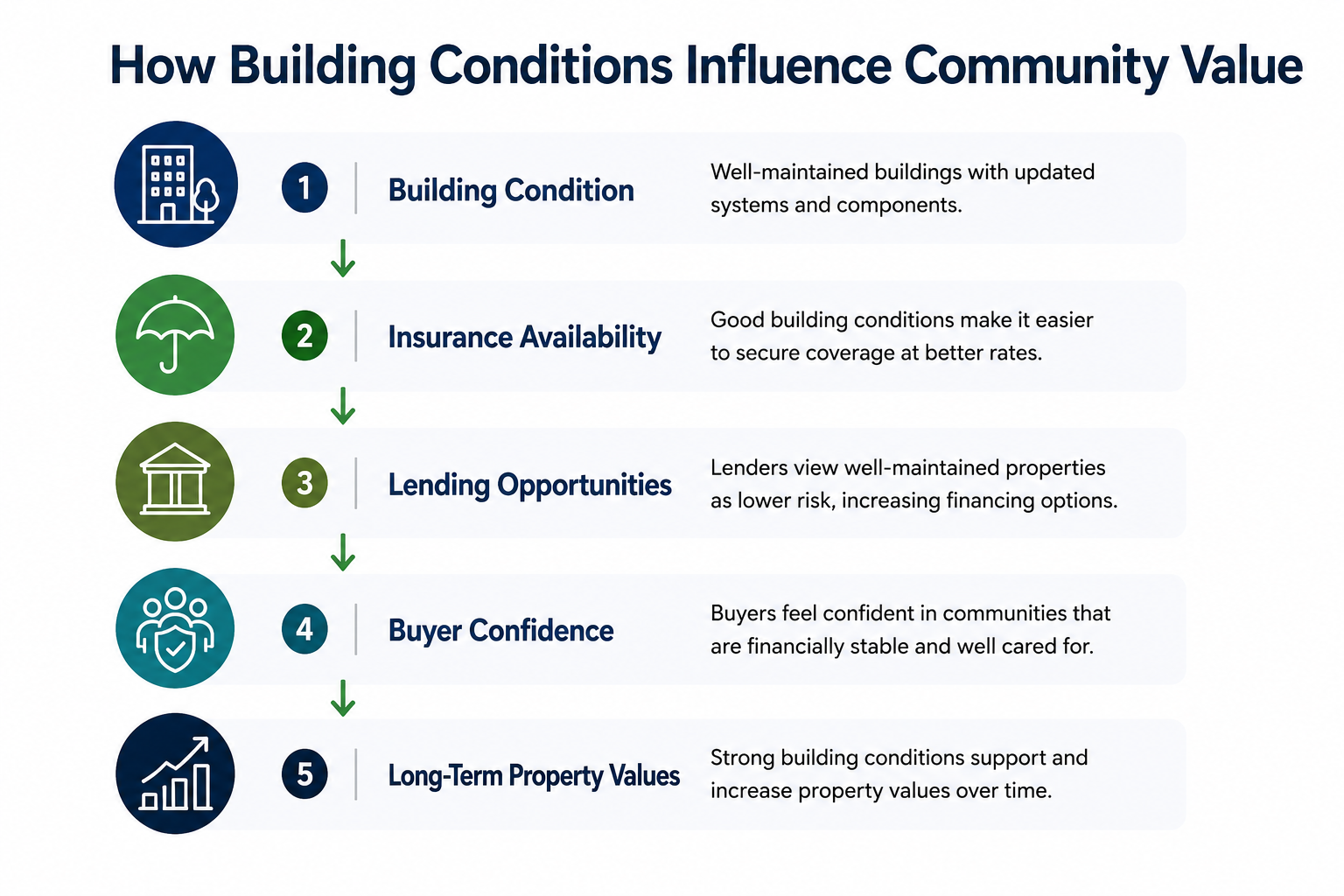
Building conditions can influence insurance availability, lending eligibility, buyer confidence, property values, and the community's overall financial stability.
As expectations from lenders, insurers, and homeowners continue to evolve, boards are increasingly expected to demonstrate that they understand their community's physical condition and have a realistic plan to address future needs.
Insurance Providers Are Paying Closer Attention
Insurance has become one of the fastest-changing challenges facing condominium communities.
Premiums have increased in many markets, coverage requirements continue to evolve, and insurance carriers are placing greater emphasis on building condition and maintenance history.
Deferred maintenance can create additional concerns during underwriting.
For example, unresolved roofing issues, deteriorated exterior components, or evidence of ongoing water intrusion may increase perceived risk for insurers. In some cases, deferred maintenance can contribute to higher premiums, coverage limitations, or additional underwriting requirements.
While every insurance provider evaluates risk differently, maintaining buildings proactively generally places communities in a stronger position when seeking competitive coverage.
Lending Requirements Continue to Evolve
Lending standards have also changed significantly in recent years.
Government-backed mortgage programs and secondary mortgage market participants have increased their focus on the financial and physical condition of condominium communities.
While specific lending requirements continue to evolve, the overall direction is clear: communities that demonstrate stronger financial planning and responsible maintenance practices are generally better positioned to maintain access to financing opportunities.
When financing options become more limited, prospective buyers may have fewer borrowing opportunities available, reducing the overall pool of qualified purchasers.
Although this does not affect every community equally, boards should recognize that financial planning and maintenance decisions can have impacts beyond the association's operating budget. They may also influence future marketability.
Transparency Strengthens Better Decision-Making
One of the recurring themes throughout the webinar was that strong leadership depends on transparency.
Condominium owners understand that major repairs are part of owning and maintaining a community.
What often creates frustration is not the project itself, but feeling surprised by it.
When significant repairs, reserve shortfalls, or known building deficiencies are not clearly communicated, homeowners may lose confidence in the planning process. New owners may purchase into a community without understanding upcoming financial obligations, while existing owners may question why expensive projects suddenly become urgent.
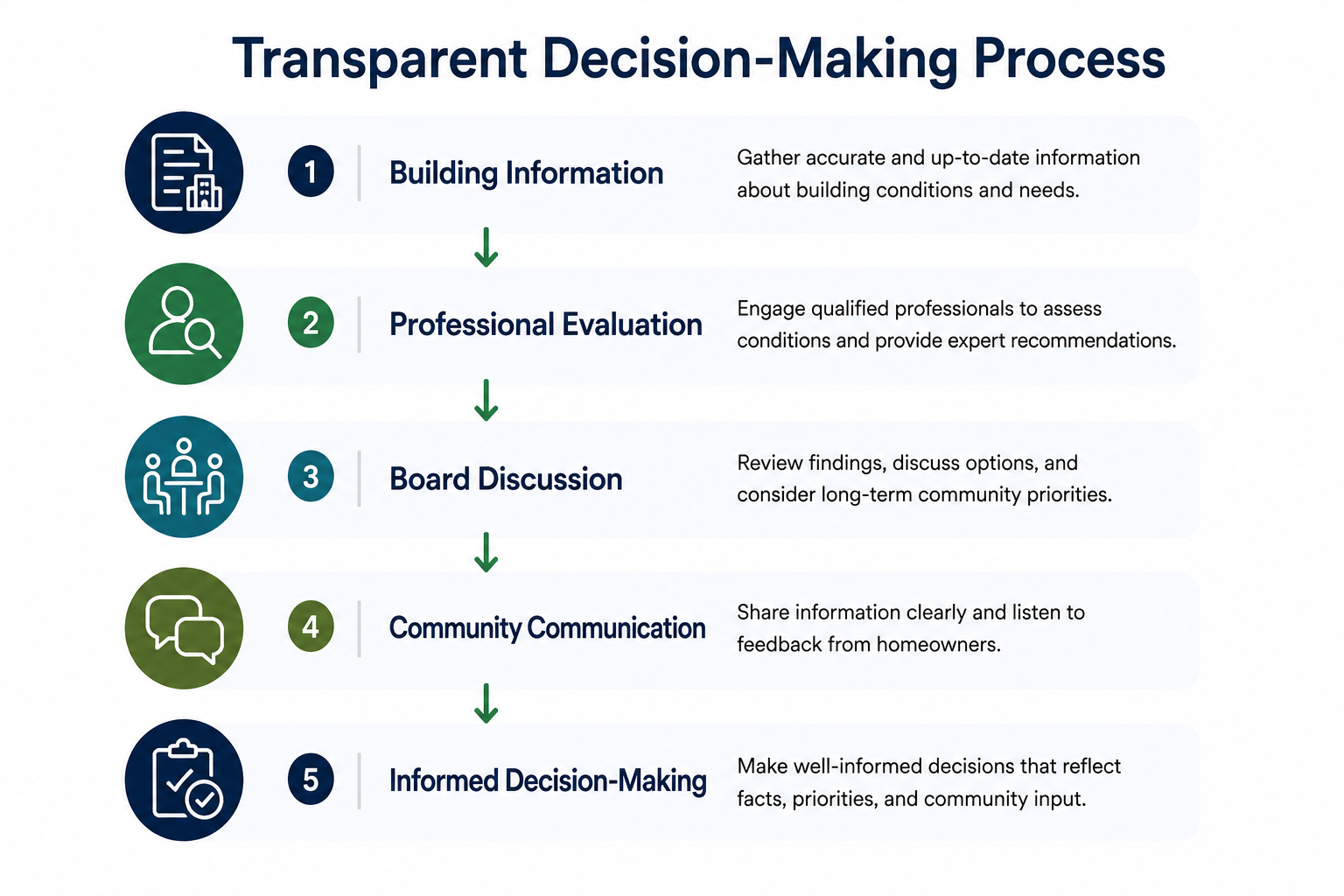
Transparent communication helps reduce those surprises by creating shared understanding between boards, property managers, and homeowners.
Documentation Supports Better Governance
Transparency begins long before a project reaches construction.
It starts with documenting building conditions, obtaining professional evaluations, discussing future capital needs, and clearly communicating why projects are recommended.
When boards rely on documented information rather than assumptions, they are better positioned to explain difficult decisions to homeowners.
This approach also creates continuity between successive boards, allowing future leaders to understand previous decisions and continue long-term planning rather than starting over each election cycle.
Good documentation is not simply administrative—it is part of responsible governance.
Communication Builds Community Trust
Major restoration projects often require increased reserve contributions, special assessments, financing, or temporary disruptions to residents.
Without context, these decisions can appear reactive or unnecessary.
Providing homeowners with clear information about:
- existing building conditions,
- project priorities,
- funding strategies,
- expected timelines, and
- long-term benefits,
helps communities understand that these decisions are part of a broader plan rather than isolated expenses.
Open communication cannot eliminate every disagreement, but it can improve trust by helping homeowners understand the reasoning behind difficult decisions.
Common Misconceptions About Fiduciary Responsibility
Discussions about reserve funding and condominium governance are often influenced by assumptions that may not reflect the long-term needs of the community.
Recognizing these misconceptions can help boards make more informed decisions.
Misconception #1: Keeping Fees Low Always Protects Property Values
Lower monthly assessments are often viewed as a selling point.
However, low fees alone do not necessarily make a community financially healthier or more attractive to prospective buyers.
If lower fees result in deferred maintenance, inadequate reserve funding, or deteriorating building conditions, the long-term impact may outweigh the short-term savings.
Well-maintained communities with thoughtful financial planning are often better positioned to preserve long-term property values than communities that consistently postpone necessary investments.
Misconception #2: Phasing Projects Always Saves Money
Phasing a large project can sometimes make practical sense.
For example, construction logistics, seasonal constraints, or operational considerations may support completing work in stages.
However, phasing should not automatically be viewed as a cost-saving strategy.
If projects are delayed solely because funding is unavailable, inflation, additional deterioration, and repeated mobilization costs may ultimately increase total project expenses.
Each situation should be evaluated individually rather than assuming phased construction is always the least expensive option.
Misconception #3: Reserve Funding Is Just About Meeting Minimum Guidelines
Minimum reserve contribution guidelines may satisfy certain lending expectations, but they do not necessarily indicate that a community is financially prepared for future capital projects.
Every condominium has different buildings, different maintenance histories, and different replacement schedules.
Effective reserve funding should be based on the actual needs of the community rather than a single percentage or benchmark.
Long-term financial planning is far more individualized than simply meeting a minimum contribution target.
Misconception #4: Fiduciary Duty Is Only About Avoiding Liability
While fiduciary duty certainly has legal implications, approaching it only from a liability perspective misses the broader opportunity.
Strong fiduciary leadership creates healthier buildings, more predictable financial planning, greater homeowner confidence, and stronger communities over time.
In other words, fiduciary duty is not simply about reducing legal exposure.
It is about making informed decisions that support the long-term success of the association.
Frequently Asked Questions
What Is Fiduciary Duty for a Condominium Board?
Fiduciary duty is the legal and ethical responsibility of board members to act in the best interests of the condominium association as a whole.
That responsibility extends beyond managing the annual budget. It includes protecting common property, making informed financial decisions, planning for future capital needs, and maintaining transparency with homeowners.
Rather than focusing on individual preferences or short-term pressures, fiduciary duty requires boards to consider the long-term health and sustainability of the entire community.
Does Fiduciary Duty Mean Every Community Must Have Fully Funded Reserves?
Not necessarily.
Every condominium community has different buildings, maintenance histories, financial resources, and future capital needs.
The webinar emphasized that reserve funding should reflect the specific needs of the community rather than a universal percentage or benchmark. A financially healthy community is one that understands its future obligations, develops a realistic funding strategy, and communicates that strategy clearly with homeowners.
Why Is Deferred Maintenance Such a Significant Risk?
Deferred maintenance affects far more than the immediate repair.
As building components continue to deteriorate, repair scopes often become larger and more expensive. Inflation, material costs, and labor costs may also increase over time, making projects more expensive than if they had been completed earlier.
In addition to increasing repair costs, deferred maintenance may affect insurance, lending opportunities, buyer confidence, and long-term property values.
How Can Boards Make Better Long-Term Decisions?
Strong long-term planning begins with understanding the actual condition of the property.
Boards should combine technical evaluations, reserve studies, financial planning, and professional guidance to identify future capital needs before they become emergencies.
Once building conditions are understood, boards can evaluate funding options, establish priorities, and communicate a long-term strategy with homeowners.
This process creates more informed decision-making and reduces the likelihood of reactive maintenance.
Why Is Transparency So Important?
Major restoration projects rarely surprise professionals—but they often surprise homeowners.
Providing clear communication about building conditions, reserve funding, future projects, and financial planning helps owners understand why decisions are being made.
Transparency builds trust, improves community engagement, and allows homeowners to prepare for future financial obligations rather than being caught off guard.
Condominium Board Leadership Checklist
Before making significant financial or maintenance decisions, boards should consider the following questions:
Understanding the Community
✔ Do we understand the current condition of our major building systems?
✔ Have qualified professionals evaluated significant maintenance concerns?
✔ Are we making decisions based on documented building conditions?
Financial Planning
✔ Does our reserve funding strategy reflect our community's actual future needs?
✔ Have we evaluated multiple funding options before delaying important work?
✔ Are we balancing today's financial pressures with tomorrow's capital obligations?
Governance
✔ Are our decisions being made in the best interests of the entire association?
✔ Have we documented the reasoning behind significant decisions?
✔ Are we relying on qualified experts when specialized knowledge is required?
Communication
✔ Have homeowners been informed about major building conditions?
✔ Have upcoming projects and funding strategies been communicated clearly?
✔ Are we creating transparency that helps homeowners understand long-term planning?
Putting Fiduciary Duty Into Practice
Fiduciary duty has always been a cornerstone of condominium governance, but today's environment places greater emphasis on how boards fulfill that responsibility.
Reserve funding expectations continue to evolve. Insurance carriers are paying closer attention to building conditions. Lending requirements are becoming more rigorous, and homeowners increasingly expect transparency about the long-term health of their communities.
Meeting these expectations requires more than balancing annual budgets.
It requires understanding the physical condition of the property, planning for future capital needs, communicating openly with homeowners, and making decisions that prioritize the long-term interests of the association over short-term pressures.
No community can eliminate every challenge or avoid every difficult decision.
However, communities that combine technical expertise, thoughtful financial planning, and transparent leadership are better positioned to protect their buildings, preserve property values, and create a stronger future for everyone who calls the community home.
Comments