
When condominium trustees and property managers discuss financial health, conversations almost instinctively gravitate toward balancing the annual operating budget, curbing fee hikes, or evaluating reserve funds for upcoming capital repairs.
Yet, as communities navigate increasingly complex infrastructure demands, right-sizing an association fee is only half the equation. The other half is just as critical: ensuring that once funds are collected, they are systematically protected, independently verified, and securely accounted for.
Financial vulnerabilities within an association rarely announce themselves with dramatic warnings. Instead, they develop quietly. Gradual board turnover, frequent management transitions, outdated banking protocols, or simply relying on "the way we’ve always done it" can create blind spots that leave communities exposed to unauthorized transfers, vendor billing errors, cyber fraud, and liability disputes.
Treating your community association like the multimillion-dollar corporation it actually is requires moving past passive trust and into structured, transparent financial stewardship.
Key Takeaway
Delegation does not transfer accountability: Hiring a professional property management company or outside bookkeeper streamlines day-to-day operations, but legal fiduciary responsibility remains squarely with the board of trustees. Establishing dual-authorization controls, independent monthly reviews, and updated bank signature cards protects both the association’s assets and its volunteer leaders.
The Fiduciary Reality: Operating as a Multimillion-Dollar Corporation
It is easy for volunteer trustees of a 20-, 50-, or 100-unit condominium to view their association informally. After all, the people walking down the hall or across the courtyard are neighbors.
However, simple math quickly reveals a different perspective. A 100-home community where units average $400,000 represents a $40,000,000 real estate asset. Over a 30-year lifecycle, that same community will easily cycle through $4,000,000 or more in capital maintenance and envelope restorations, covering roofs, siding, masonry, windows, and decks.
Under state statutes and governing master deeds, boards owe an unyielding fiduciary duty to the entity itself (the association) to protect and preserve this asset.
A frequent misconception among volunteer trustees is that handing administrative duties over to a professional property management firm transfers legal liability away from the board. Condominium attorneys consistently emphasize that almost every standard management agreement includes clear indemnification clauses: the association agrees to hold the management agent harmless for standard operational acts and honest missteps, barring gross negligence or intentional malfeasance.
If an unauthorized invoice is paid, a critical utility bill is overlooked, or funds are misallocated, the financial liability lands squarely on the association. Establishing internal checks and balances is not a sign of distrust toward your management team; it is an indispensable system of mutual protection that ensures alignment between operational staff and governing boards.
To learn more about how to transform your community's financial future, download The Power of Right-Sized Condominium Fees HERE.
Pillar 1: Essential Banking Controls & Dual Authorizations
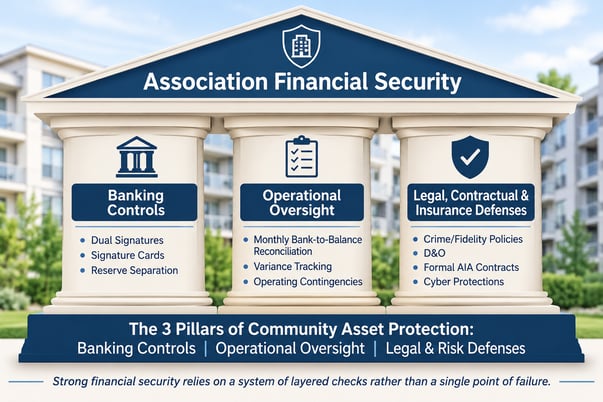
The most direct way to safeguard community money is to govern how it enters and leaves association accounts. Every community should implement three fundamental banking practices:
1. Mandatory Dual Signatures on Significant Disbursements
Never allow a single individual (whether an outside property manager or an individual board officer) to possess sole discretion over sizable expenditures.
- Establish Clear Thresholds: Formalize Standard Operating Procedures (SOPs) specifying which recurring expenses can be automated (such as scheduled monthly utilities, trash removal, and contracted landscaping) versus what requires two separate trustee authorizations (i.e., any non-routine invoice over $2,500, $5,000, or $10,000).
- Leverage Cloud Approvals: Implementing dual controls no longer means waiting weeks for paper checks to circulate through physical mailboxes. Modern association management platforms (such as AppFolio or Yardi) allow designated trustees to review scanned invoice images, verify backup work orders, and electronically approve disbursements directly from a smartphone or tablet.
2. Routine Updates of Bank Signature Cards
One of the most common administrative oversights in community associations stems from stale banking records. Trustees rotate off boards, relocate, or pass away, yet their names remain active signers on commercial accounts for 5, 10, or even 15 years.
- The Annual Banking Ritual: Immediately following your community’s annual meeting and the recording of your updated Certificate of Trust, schedule a visit to your financial institutions. Present valid identification and newly executed corporate resolutions to remove departed members and register incoming trustees. If an account lacks active signers, banking institutions may freeze access during critical emergencies, or worse, departed members could technically retain legal withdrawal authority.
3. Clear Separation Between Operating and Reserve Accounts
Operating capital and reserve savings serve fundamentally different purposes and must live in distinct, dedicated accounts.
- Avoid Informal "Borrowing": Operating shortfalls caused by an unusually severe winter or unexpected utility spikes should never be resolved by quietly siphoning money from reserve accounts without formal documentation.
- Enforce "Due To/Due From" Accounting: If an extraordinary emergency forces an association to tap reserve balances to cover an immediate operational need, the transaction must be explicitly booked on the balance sheet as an inter-fund liability ("Due to Reserves from Operating"). The board should establish a structured, short-term repayment schedule, ideally repaid within the same fiscal year through a supplemental assessment or adjusted operating fee, rather than letting reserves permanently subsidize operating deficits.
Pillar 2: Active Monthly Review vs. Passive Acceptance
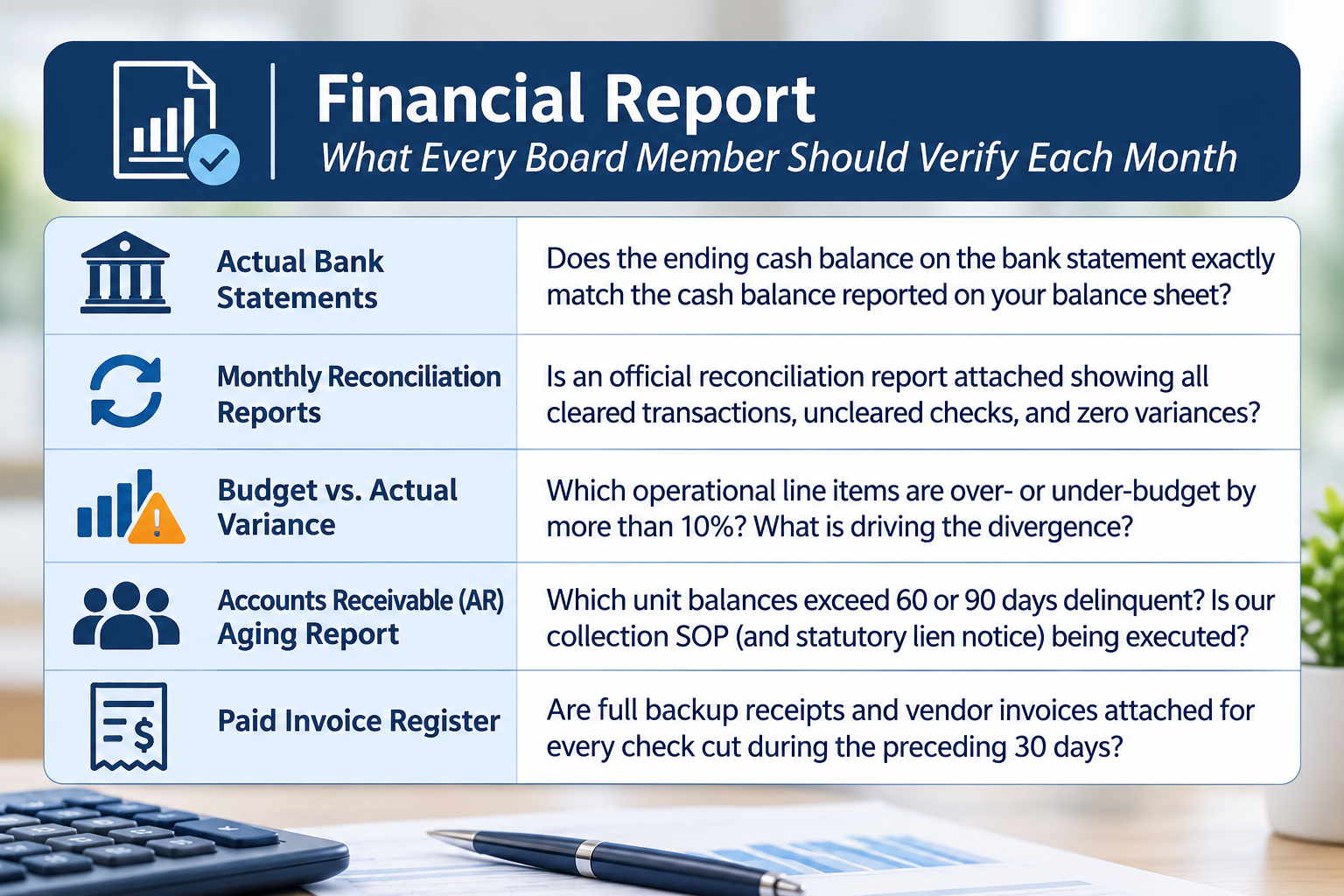
Volunteer board members lead busy lives, and reviewing monthly financial packets can feel daunting. However, fulfilling your fiduciary obligation does not require auditing every paper clip; it requires asking targeted, consistent questions about key reports.
Build an Operating Contingency Line Item
One practical budgeting strategy that protects both operating and reserve funds is incorporating an annual operating contingency line item into the yearly budget.
Inflation and supply chain shifts have significantly increased the cost of routine maintenance materials and emergency service calls. Budgeting a dedicated contingency buffer (ranging from $5,000 to $25,000 depending on community size), gives management the liquidity to address unexpected winter storm clearing, minor plumbing repairs, or small equipment servicing without exceeding the operating budget or raiding capital reserves. If those funds go unused by year-end, they can be systematically transferred to bolster reserve balances.
Pillar 3: Defending Against Cyber Risks, Contract Gaps, and Liability
Even the most diligent internal accounting processes cannot prevent every external vulnerability. A comprehensive risk management strategy requires robust safeguards against digital fraud, contractor disputes, and liability exposures:
1. Cyber Security and Wire Fraud Vigilance
Cyber criminals increasingly target community associations, viewing them as cash-rich organizations governed by part-time volunteers.
- The "Urgent Payment" Red Flag: Phishing schemes often mimic legitimate contractors or management personnel, claiming an urgent cash shortage and requesting immediate wire transfers, sometimes even offering a discount in exchange for rapid payment to an overseas or unverified account.
- Strict Verification Protocols: Establish an unbreakable verification protocol: never execute a wire transfer, update vendor bank routing details, or modify payment instructions based solely on an email request. Always confirm the request via a known, independent phone number with the primary vendor contact.
2. Guarding the Board with Adequate D&O and Fidelity Coverage
Most governing documents require commercial general liability insurance, but general liability policies do not shield individual trustees from allegations of administrative errors, budgeting shortfalls, or disputed board decisions.
- Review D&O Sub-Limits: A standard $1,000,000 aggregate Directors & Officers policy split among five or seven board members may provide inadequate defense coverage in complex disputes. Review policies annually with an independent insurance advisor to ensure coverage limits reflect the true replacement value and scale of the property.
- Crime & Fidelity Bonds: Ensure the community carries comprehensive crime and fidelity coverage that explicitly covers computer fraud, wire fraud, and dishonest acts by both elected board members and third-party management agents who maintain access to association funds.
- Mandatory HO-6 Policies: Governing documents should require all unit owners to maintain active HO-6 condominium insurance policies. When envelope issues or internal plumbing leaks occur, properly insured homeowners minimize cross-unit disputes and prevent protracted subrogation battles.
3. Formalized Construction Contracts and Draw Schedules
Major capital maintenance projects, such as roofing replacements, siding overhauls, or masonry rebuilding, involve substantial financial outlays. Handling these initiatives under informal contractor estimates or one-page proposals introduces significant risk.
- Standardized Contracts: Always execute formal, industry-standard contracts (such as American Institute of Architects [AIA] documents). These agreements include critical protections covering retainage, mandatory lien waivers, milestone inspections, schedule compliance, and proof of comprehensive insurance before work commences.
- Multi-Tiered Payment Approvals: Never release substantial progress payments without independent verification. Disbursements should require sign-off from both the project's supervising consultant or engineer and designated board trustees to confirm that installed materials match specifications.
Connecting Long-Term Capital Planning to Physical Building Reality
Financial oversight cannot exist in a vacuum separated from physical building realities. Having healthy bank balances provides little comfort if a board has no clear understanding of when building envelope components will reach the end of their useful lives or what major replacements will realistically cost.
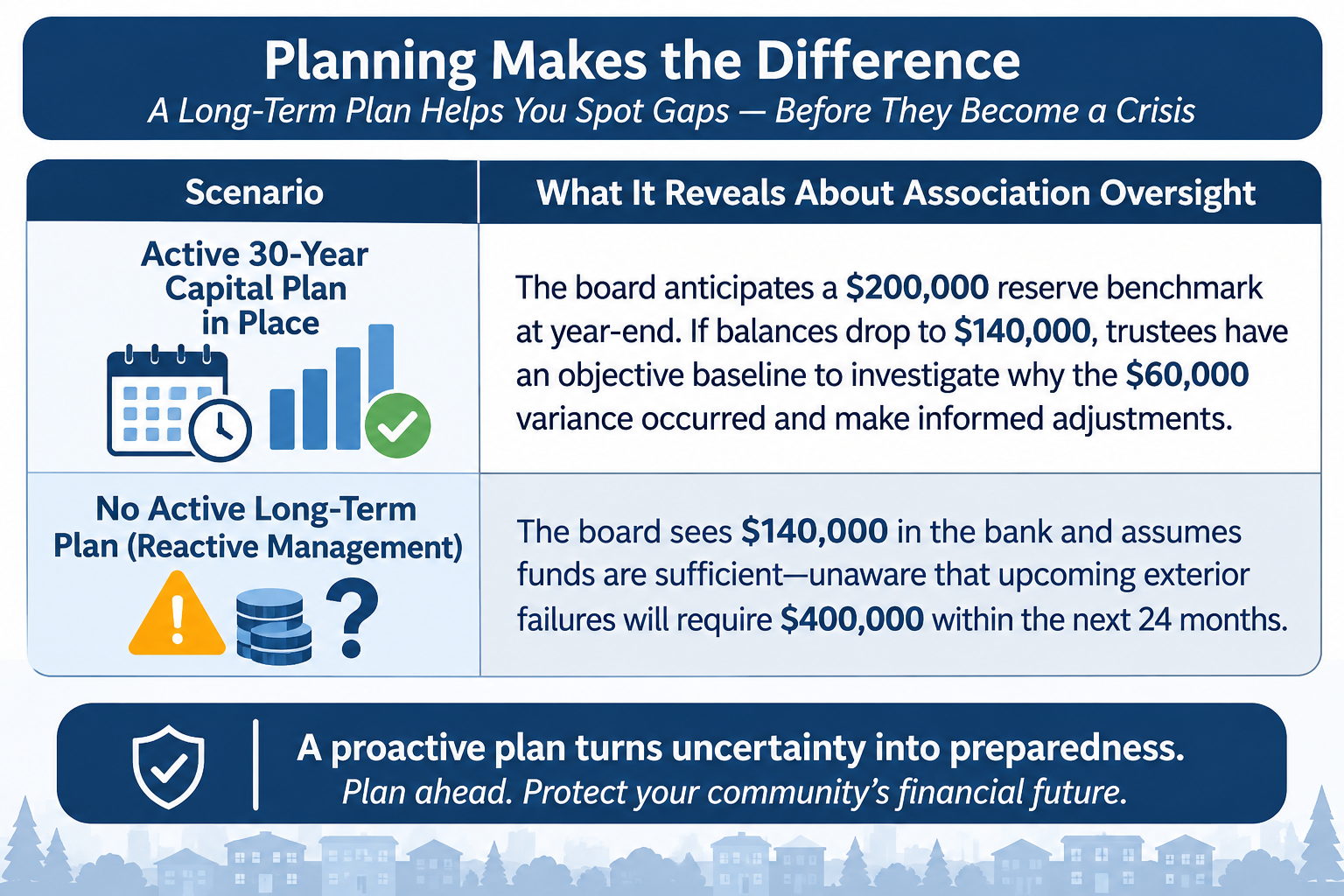
An active, realistic capital plan functions as a financial benchmark. As highlighted in the scenario above, when a board projects where reserve levels should stand at the end of each fiscal year, any variance becomes an immediate prompt for constructive questions: Did an emergency repair consume capital? Did material pricing surge? Were reserve contributions skipped?
Without a detailed capital plan connected to verified physical conditions, boards have no basis for comparison. Long-term asset preservation requires uniting physical building data, realistic cost modeling, and disciplined banking controls into an integrated, multi-year roadmap.
To learn more about how to create an action plan for common elements that aligns with actual current building conditions, download From Study to Strategy HERE.
Frequently Asked Questions (FAQ)
What is the practical difference between a board's fiduciary duty and a property manager's role?
A property management company serves as an agent of the trust, handling operational coordination, routine contractor oversight, and accounting administration. However, legal fiduciary responsibility (the fundamental duty to maintain the common elements, protect association capital, and authorize financial disbursements) remains exclusively with the elected board of trustees under the law.
Will serving as an authorized bank signer increase a trustee’s personal legal liability?
No. In fact, delegating all payment authority to an outside party without oversight increases community vulnerability. Standard property management agreements typically indemnify management companies for ordinary operational acts; if unauthorized or negligent disbursements occur, liability typically defaults back to the association. Serving as an authorized signer provides essential transparency and control, safeguarding both the community and individual trustees.
Does our association need an independent CPA audit or review every year?
Statutory audit requirements can vary based on unit count and annual revenues. However, scheduling an independent financial review immediately following the completion of a major, multi-phase capital restoration project ensures all contractor payments, retainages, and loan disbursements are fully reconciled.
How should a community handle debit cards issued to maintenance staff?
If an association chooses to provide maintenance personnel with a payment card for routine hardware store purchases, strict operational guardrails are essential: establish hard limits (such as $1,000 to $2,000), require itemized physical receipts for every transaction within 48 hours, and maintain a clear policy prohibiting non-maintenance purchases or cash advances.
What steps should a board take if a fellow trustee is not upholding their fiduciary duties?
When a board member neglects their duties or ignores financial safeguards, the board should first review its governing documents to understand the legal thresholds for trustee removal or recall. Addressing concerns directly through formal written communication often resolves issues or prompts a voluntary resignation. If serious willful misconduct or financial harm has occurred, the board should immediately consult association legal counsel to evaluate formal legal remedies.
Closing Thoughts
Sound financial risk management is not about creating suspicion or complicating daily operations; it is about providing community leaders with the structural safeguards necessary to govern with confidence. By adopting dual-signature approvals, reviewing monthly accounts with common-sense diligence, guarding against cyber vulnerabilities, and aligning reserve balances with real building lifecycles, boards can protect their community’s investments today and for decades to come.
To learn more about this topic, watch the webinar recording of Financial Security & Risk Management HERE.
Comments