
Have you ever received dramatically different prices from reputable contractors for what appeared to be the same condominium restoration project? If both contractors are qualified and looking at the same buildings, how can their prices be so different—and how is a board supposed to know which proposal truly reflects the community's needs?
For decades, competitive bidding has been the traditional approach for pricing exterior maintenance and repair projects in condominium communities. When communities were newer and projects were relatively straightforward, with clearly defined scopes of work, this process generally served its purpose.
Today's major restoration projects, however, present a different set of challenges. Aging communities may be dealing with roofs, siding, windows, balconies, waterproofing systems, and other interconnected building envelope components at the same time. Many important existing conditions are also concealed behind finished materials and cannot be fully understood through visual inspection alone.
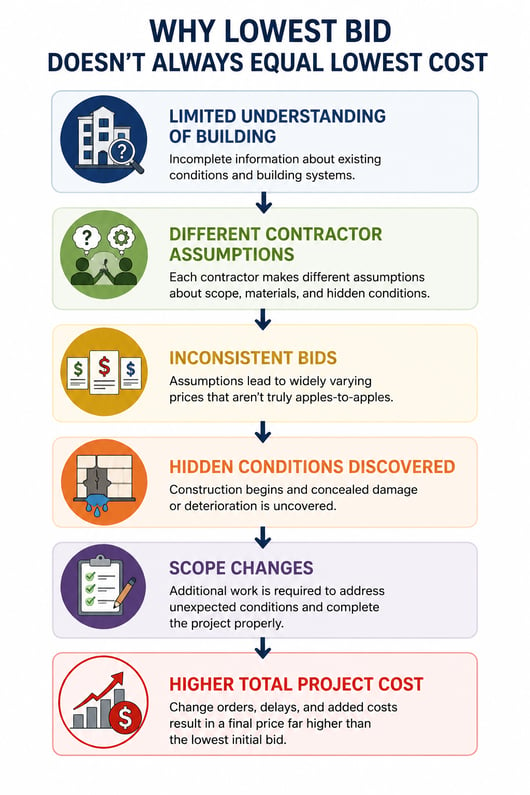
When contractors are asked to price a project before those conditions are understood, each may make different assumptions about the work that will ultimately be required. The result can be dramatically different bids, scope revisions, change orders, and unexpected costs once construction begins.
Integrated Project Delivery offers a different approach. By bringing owners, engineers, contractors, and other key stakeholders together earlier in the planning process, communities can develop restoration projects around better technical information, greater collaboration, and a clearer understanding of the building's actual needs.
Rather than measuring success by the lowest initial price, Integrated Project Delivery focuses on delivering the greatest long-term value while reducing uncertainty, minimizing risk, and protecting the community's investment.
Key Takeaways
- Competitive bidding can be effective when a project's scope is clearly defined, but complex restoration projects often involve concealed conditions that make accurate upfront pricing difficult.
- Integrated Project Delivery brings key stakeholders together earlier to improve collaboration, technical planning, transparency, and decision-making.
- Comprehensive diagnostic analysis helps establish the actual condition of the building before the restoration scope and pricing are finalized.
- Reserve studies and diagnostic analyses serve different purposes and work best when used together.
- The lowest initial price does not necessarily provide the greatest long-term value when important installation details or existing conditions are missing from the scope.
- Successful exterior restoration depends on both quality materials and proper installation by professionals who understand building envelope science.
Why Lowest Bid Doesn't Always Mean Lowest Cost
Choosing the lowest qualified bid can appear to be the most financially responsible decision a condominium board can make. But on a complex restoration project, the lowest initial price does not necessarily represent the lowest total project cost.
The challenge is that contractors may not actually be pricing the same project.
Traditional bid forms often focus heavily on visible materials and quantities—such as roofing, siding, decking, or trim—while providing less detail about installation requirements, underlayments, flashing, weatherproofing, fasteners, and other components that determine how the building envelope will perform.
Existing conditions create another layer of uncertainty. Moisture damage, deteriorated sheathing, failed flashing, damaged framing, and other concealed conditions may not be known when the initial scope is developed.
One contractor may account for more of these risks in its proposal, while another may price only what is explicitly included in the bid documents. Both proposals may appear valid, but they may not represent the same scope or level of long-term performance.
If necessary work is identified after construction begins, those items must be added to the project—often through change orders and price increases.
For condominium boards, the goal should therefore be more than identifying the lowest initial bid. It should be developing a sufficiently detailed scope so that pricing reflects the work actually required to protect the community's buildings.
The Low-Bid Trap
A lower initial price can be appealing, particularly when a board is trying to manage a major capital investment responsibly.
However, when bids are developed without a comprehensive understanding of the building, comparing proposals is rarely a true apples-to-apples exercise.
We worked with a condominium community that selected the lowest proposal because it appeared to provide substantial savings. Once construction began, essential weatherproofing details and installation requirements that had not been fully reflected in the original bid needed to be incorporated into the project.
Those necessary additions resulted in unexpected and frustrating price increases.
The problem was not simply the contractor. It was the bidding process itself. When critical installation requirements are not clearly incorporated into the original scope, they may appear later as additional costs even though they are necessary to complete the restoration properly.
What Is Integrated Project Delivery?
Integrated Project Delivery (IPD) is a collaborative project delivery method. The Lean Construction Institute defines formal IPD as a model in which key parties involved in design, fabrication, and construction are brought together under a single agreement. This structure supports continuous communication throughout the project and aligns participants around shared goals.
In condominium restoration, these same integrated principles can be applied by involving the owner, engineer, restoration specialist, contractor, and other stakeholders earlier in the planning process. Even when a project does not use a formal multi-party IPD contract, early collaboration can reduce miscommunication and waste, uncover constructability concerns before work begins, and limit avoidable revisions and change orders.
Rather than having each party work independently, participants work toward shared project goals and prioritize transparency, accuracy, collaboration, and accountability.
For condominium restoration, the process begins with understanding the building.
A specialist in condominium replacement and restoration conducts a comprehensive diagnostic analysis to determine the condition and performance of the building envelope. That information is used to establish a formal diagnosis and develop a corresponding scope of work, specifications, and pricing.
Engineering expertise provides another important layer of oversight. An engineering firm can offer a second opinion on the diagnosis and proposed solution, provide design input where necessary, and independently review proposed project costs.
Homeowner education is also incorporated into the process. Meetings can help owners understand project goals, evaluate exterior material options, discuss funding considerations, and develop greater alignment around the restoration strategy.
The result is a planning process built around shared information rather than separate assumptions.
Integrated Project Delivery Is More Than a Different Way to Bid
Integrated Project Delivery should not simply be viewed as another bidding strategy. It represents a fundamentally different project planning model.
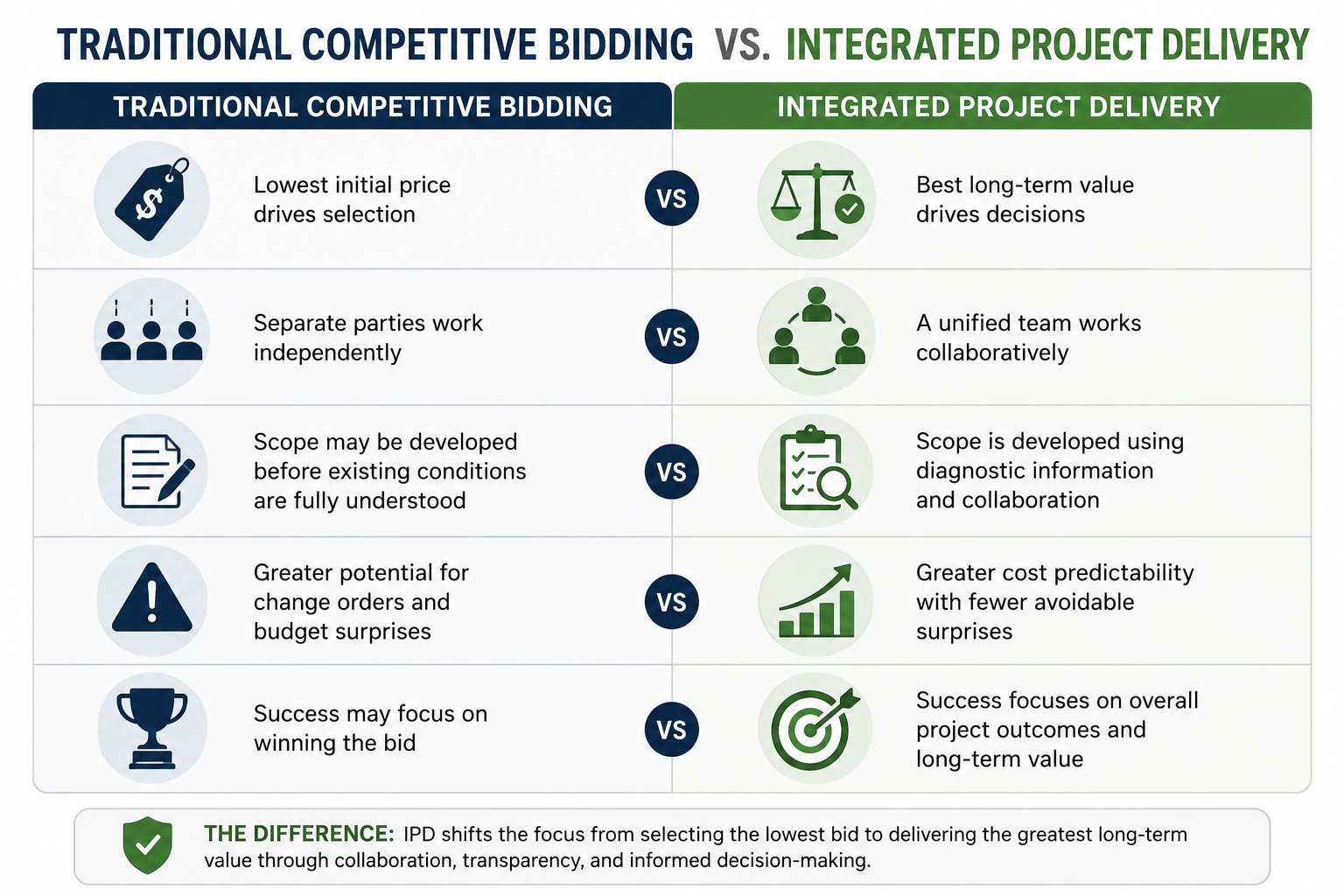
Traditional competitive bidding typically develops the scope first and then asks contractors to price that scope. This works well when the project can be accurately defined in advance.
Complex condominium restoration often makes that difficult.
Integrated Project Delivery shifts more technical investigation and collaboration to the beginning of the process so that the diagnosis, proposed solution, specifications, pricing, and funding discussions are informed by a more complete understanding of the building.
How Integrated Project Delivery Can Reduce Cost and Hassle
With traditional bidding, differences in interpretation can lead to widely varying prices. When proposals come in higher than expected, boards may feel pressure to revise the project scope simply to bring the initial price closer to the available budget.
Those budget-driven revisions can create problems when important installation details or weatherproofing requirements are removed without fully understanding their role in the building envelope.
Integrated Project Delivery addresses this problem by developing the project around a more complete understanding of existing conditions before major construction decisions are finalized.
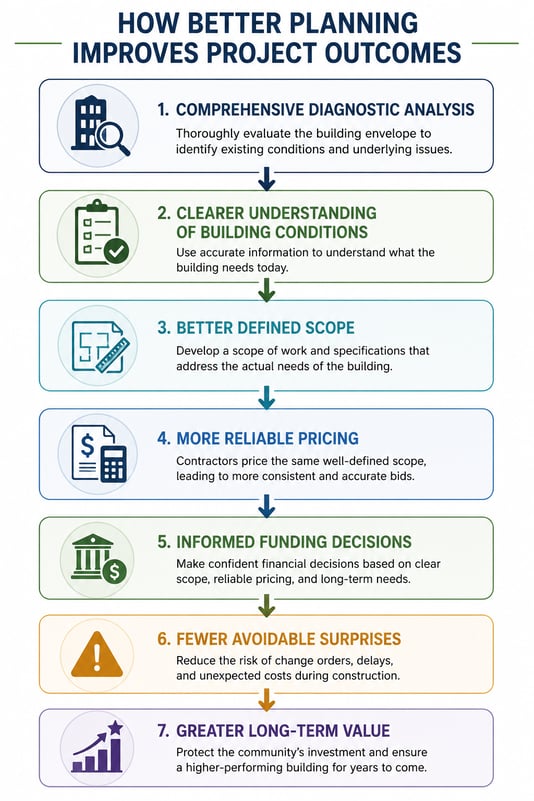
A comprehensive diagnostic analysis informs the diagnosis. The diagnosis informs the proposed solution. The solution informs the scope, specifications, and pricing.
This creates a clearer connection between what the building needs and what the community is being asked to fund.
The objective is not simply to make the initial price appear lower. It is to create more reliable pricing expectations, reduce avoidable revisions, and help the community understand what it is paying for and why.
A Fair Price Is More Than the Lowest Price
Both traditional bidding and Integrated Project Delivery can be intended to produce fair pricing.
The difference is the information behind the price.
When the scope is based on a detailed understanding of the building, boards can evaluate project costs in the context of the work actually required. This reduces the risk of selecting an apparently lower price that later increases when omitted or unidentified work becomes necessary.
For major restoration projects, long-term value should therefore be considered alongside initial project cost.
Why Comprehensive Diagnostic Analysis Matters
One of the most important parts of planning a major exterior restoration project is understanding what is happening beneath the visible exterior materials.
A comprehensive diagnostic analysis evaluates the condition and performance of the building envelope—the interconnected exterior components and weatherproofing barriers that work together to protect the structure from water intrusion and other weather-related risks.
Because these components function together, deterioration or improper installation in one location can affect the performance of surrounding systems.
Simply replacing visible exterior materials without understanding what is happening behind them may leave underlying problems unresolved.
A diagnostic analysis may involve selectively removing portions of exterior finishes to evaluate underlying structure, weatherproofing barriers, flashing, and other concealed components that cannot be assessed through visual inspection alone.
This information provides a stronger foundation for developing the scope and pricing around data and actual building conditions rather than guesswork.
Hidden Conditions Can Change the Entire Project
Moisture intrusion, deteriorated sheathing, failed flashing, damaged framing, and other concealed conditions may not become apparent until portions of the building are opened.
When these conditions are discovered after construction begins, boards may face new costs, schedule changes, and difficult decisions while the project is already underway.
No investigation can eliminate every unknown condition.
However, identifying more of those conditions during planning can reduce uncertainty and allow the project team to incorporate necessary repairs into the project strategy earlier.
A Reserve Study Is Not a Comprehensive Diagnostic Analysis
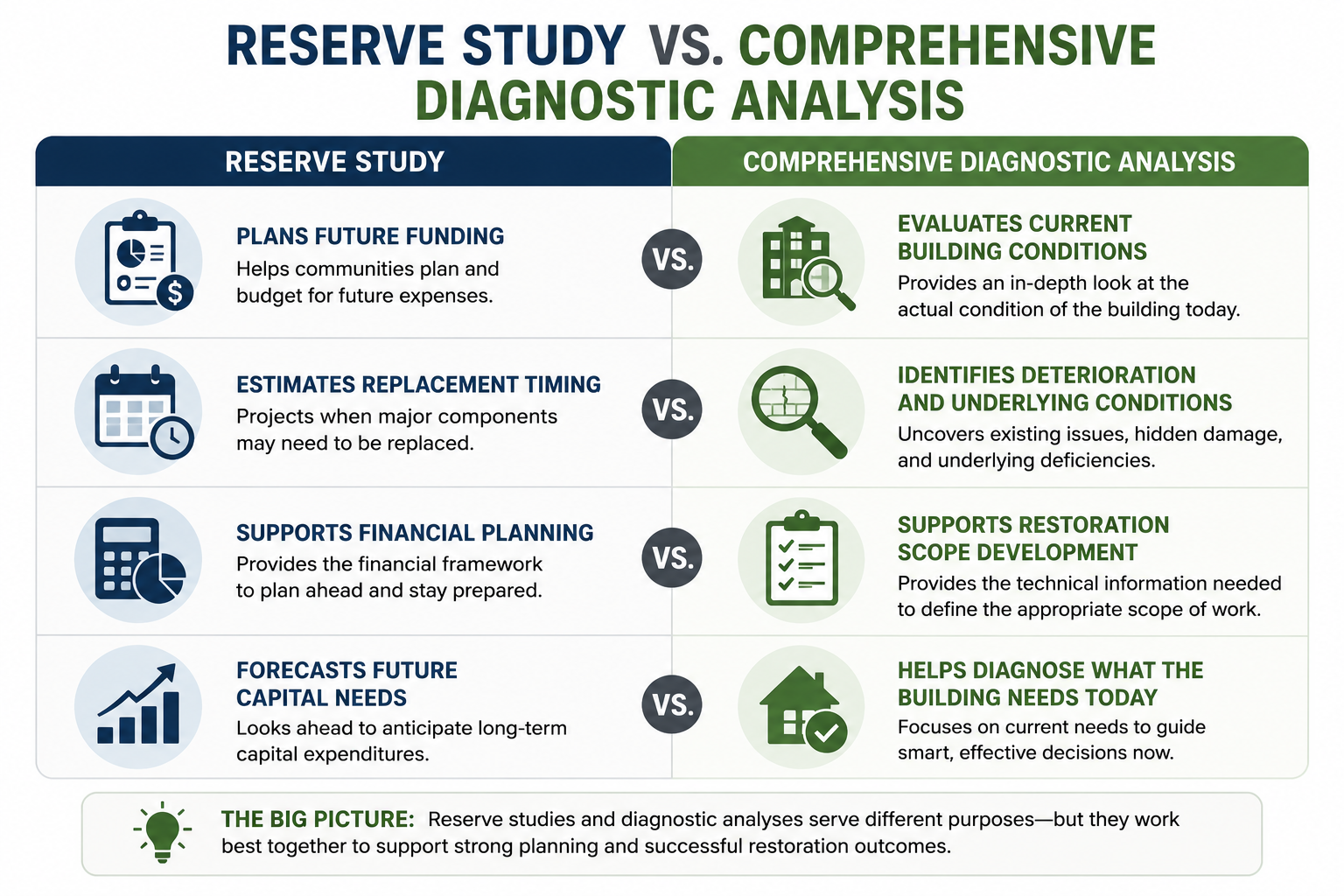
Reserve studies are among the most important long-term financial planning tools available to condominium communities. But their purpose is different from a comprehensive diagnostic analysis.
A reserve study helps estimate the timing and funding of future capital expenditures. It allows communities to anticipate when major building components may require replacement and develop a financial strategy for those future obligations.
A comprehensive diagnostic analysis answers a different question: What is the actual condition of the building today?
That distinction becomes especially important when a community is preparing for a major restoration project.
A component may appear in a reserve study as approaching the end of its expected useful life, but that does not necessarily reveal the condition of the underlying building envelope or identify the appropriate restoration solution.
Both tools are valuable, but they serve different purposes.
The Reserve Study Trap
We worked with a condominium community that relied on its reserve study to move a major restoration project into bidding.
The challenge was that the reserve study was designed primarily as a financial forecasting tool. It did not provide the comprehensive diagnostic information needed to understand concealed deterioration or determine how the building envelope was actually performing.
When a restoration project is developed using only visible conditions, contractors may replace surface materials without identifying underlying deterioration or addressing the interconnected building envelope.
That can leave hidden problems unresolved and reduce the lifespan of newly installed materials.
The Importance of Quality Installation
High-quality exterior materials alone cannot ensure that a building is protected from the elements.
Installation matters just as much.
Think of the building's weatherproofing system like a rain jacket. A high-quality rain jacket can keep you dry, but only when it is worn correctly. If the hood is disconnected or the jacket is improperly tucked into other layers, water can still reach what is underneath.
The same principle applies to a building envelope.
Flashing, weatherproofing barriers, transitions, and connections between exterior components must be installed properly to create a continuous system that directs water away from the building.
When those details are installed incorrectly, water can enter the assembly and cause deterioration even when high-quality exterior materials have been used.
Improper installation can also shorten the lifespan of a major exterior investment and create the need for costly rework in the future.
For that reason, major exterior restoration projects require contractors with specialized knowledge of building envelope science and how individual components work together.
The Estimation Trap
We worked with a condominium community where contractor proposals came in significantly higher than the architect's projected budget.
Understandably, the board began looking for ways to reduce the scope so the bids would align more closely with the original estimate.
The risk with this approach is that budget-driven scope reductions may remove components that are necessary for proper weatherproofing or long-term building performance.
Reducing the initial project cost may appear to solve the immediate financial problem, but compromising critical building envelope details can allow water intrusion and ultimately create greater costs in the future.
The Building Envelope Works as One Connected System
Roofs, siding, windows, balconies, flashing, waterproofing systems, drainage components, and structural framing do not operate independently.
They work together as one building envelope system.
A failure in one area can therefore affect components somewhere else.
Water entering at a roof transition may travel behind siding before appearing inside a building. Improper window flashing can allow moisture to reach wall sheathing or framing. Balcony waterproofing failures may affect adjacent structural components.
That is why restoration planning should consider how individual components connect rather than treating every visible problem as an isolated repair.
Understanding those relationships helps project teams address root causes, coordinate repairs, and protect the long-term performance of the building.
Think Beyond the Immediate Repair
Many major restoration projects begin with a visible concern such as recurring leaks, aging siding, deteriorated windows, or failing balconies.
The visible problem may not tell the entire story.
Before developing a solution, boards should understand whether surrounding systems or concealed conditions are contributing to the issue.
That does not mean every project needs to become larger.
It means the project scope should reflect the actual cause of the problem rather than simply addressing its most visible symptom.
Why Planning Before Construction Changes Everything
The most important decisions in a restoration project are often made long before construction begins.
During planning, the community must understand existing conditions, evaluate potential solutions, determine project priorities, consider funding options, communicate with homeowners, and establish realistic expectations for cost and scope.
Integrated Project Delivery brings those conversations together earlier.
Rather than waiting for construction to expose critical information, the project team works collaboratively to understand as much as possible before major financial commitments are made.
This creates an opportunity to evaluate materials, project sequencing, design considerations, pricing, and funding while changes are still easier to manage.
The goal is not more planning for the sake of planning.
The goal is to make important decisions using better information.
Better Planning Supports Better Financial Decisions
Major restoration projects can represent one of the largest investments a condominium association will make.
Boards must determine how work will be funded, whether reserves are sufficient, whether financing or assessments may be necessary, and how those decisions will affect homeowners.
Those decisions become more informed when the technical scope is based on a comprehensive understanding of the building.
Better technical information creates a stronger foundation for realistic financial planning.
Better Planning Improves Homeowner Alignment
Major restoration projects can also be difficult for homeowners to understand.
Residents want to know why the work is necessary, what materials will be used, how much it will cost, how it will be funded, and what the long-term benefit will be.
Integrated planning provides an opportunity to educate homeowners about the project before construction begins.
Meetings can help explain the diagnosis, proposed solution, material options, funding considerations, and project goals so owners understand not only what is being recommended, but why.
That transparency can help build greater alignment and confidence around major community investments.
Fiduciary Responsibility and Long-Term Value
Historically, many condominium boards have viewed obtaining multiple competitive bids as evidence of prudent financial stewardship.
However, fiduciary responsibility extends beyond obtaining the lowest initial price.
Board members are responsible for making informed decisions that protect the community's financial health, physical assets, and long-term property values.
For complex restoration projects, that means evaluating more than the number at the bottom of a proposal.
Boards should consider whether the scope accurately addresses the building's condition, whether the proposed solution provides appropriate long-term performance, whether project costs have been independently evaluated, and whether the planning process provides enough information to make a responsible decision.
The central question becomes less about “Who submitted the lowest bid?” and more about “Which approach provides the greatest long-term value while protecting the community?”
Recommended Next Steps for Condominium Boards
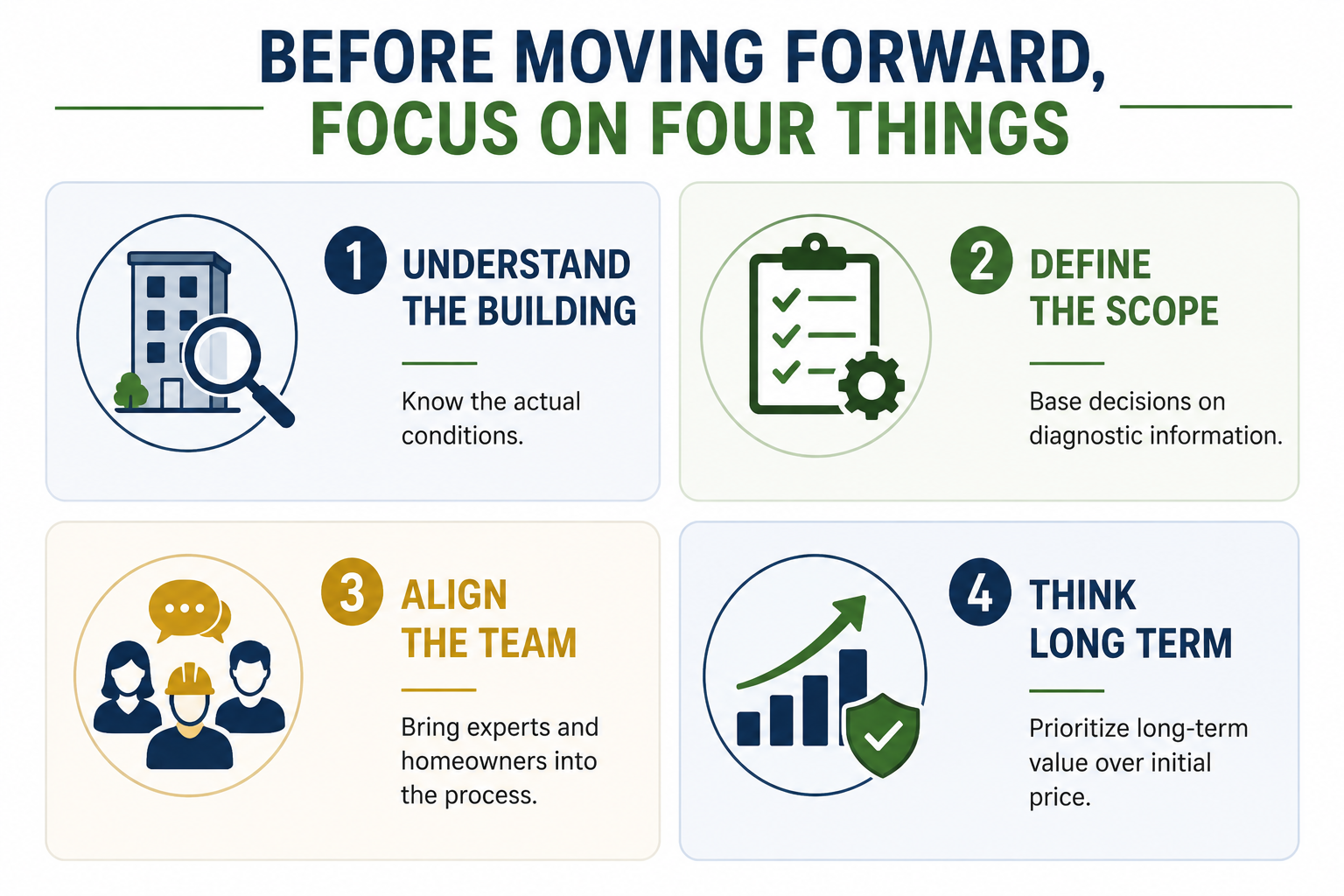
Whether your community is preparing for a major restoration project or beginning to evaluate future exterior replacement needs, strengthening the planning process can reduce uncertainty and support better decision-making.
Do We Fully Understand the Building's Condition?
Before developing the final project scope, determine whether enough information has been gathered to understand the building's actual condition.
Recurring leaks, visible deterioration, previous repairs, and aging exterior components may indicate underlying conditions that require further evaluation.
A comprehensive diagnostic analysis can provide information that visual observations alone cannot.
Are We Comparing the Same Scope?
Before comparing contractor pricing, determine whether each proposal reflects the same installation requirements, weatherproofing details, specifications, and expected project outcome.
A lower number has limited value if the proposals do not include the same work.
Have the Right Professionals Been Involved Early?
Complex restoration projects benefit from collaboration between condominium restoration specialists, engineers, property managers, board members, and other relevant professionals.
Bringing that expertise together earlier can improve the diagnosis, scope development, pricing review, and overall project strategy.
Are Homeowners Informed and Aligned?
Major restoration decisions affect the entire community.
Providing homeowners with information about building conditions, material options, project goals, costs, and funding considerations can create greater understanding before construction begins.
Are We Evaluating Long-Term Value?
The lowest initial price should not be the only measure of a successful restoration strategy.
Boards should consider project durability, building performance, future maintenance needs, potential rework, cost predictability, and the protection of the community's overall investment.
Frequently Asked Questions
What Is Integrated Project Delivery?
Integrated Project Delivery is a collaborative project delivery method that brings owners, engineers, contractors, and other key stakeholders together early in the planning process.
For condominium restoration, this allows technical information, project scope, specifications, pricing, and other important decisions to be developed around a shared understanding of the building's condition and the community's goals.
Why Isn't the Lowest Bid Always the Lowest Overall Cost?
The lowest initial proposal may not include the same scope, installation details, or assumptions as other bids.
When necessary weatherproofing details, concealed deterioration, or other required work are identified after construction begins, the project cost can increase through scope revisions and change orders.
Evaluating long-term value requires understanding what is—and is not—included in the initial price.
Why Is a Comprehensive Diagnostic Analysis Important?
Many important building envelope conditions are concealed behind exterior materials.
A comprehensive diagnostic analysis can include selective openings that allow professionals to evaluate underlying structure, weatherproofing barriers, flashing, and other components that cannot be assessed through visual inspection alone.
That information helps create a project scope based on actual conditions rather than assumptions.
How Is a Comprehensive Diagnostic Analysis Different from a Reserve Study?
reserve study primarily supports long-term financial planning by estimating future capital expenses and helping communities plan how those expenses will be funded.
A comprehensive diagnostic analysis evaluates the actual condition and performance of the building envelope and helps determine the appropriate scope of a restoration project.
Both are valuable, but they answer different questions.
Does Integrated Project Delivery Eliminate Change Orders?
No.
Existing buildings can contain concealed conditions that cannot be fully identified before construction.
Integrated Project Delivery cannot eliminate every unknown, but a more comprehensive planning and diagnostic process can reduce avoidable uncertainty and help communities enter construction with a clearer understanding of the expected work.
Why Does Installation Quality Matter So Much?
Exterior materials only perform as intended when they are properly integrated into the building envelope.
Flashing, weatherproofing, transitions, and connections between systems must work together to manage water effectively.
Improper installation can allow moisture intrusion, accelerate deterioration, and shorten the lifespan of otherwise high-quality materials.
Condominium Board Planning Checklist
Before beginning your next major restoration project, ask the following questions:
Understanding the Building
☐ Do we understand the current condition of the building envelope?
☐ Have concealed conditions been appropriately investigated?
☐ Are we addressing the root cause of deterioration rather than only visible symptoms?
Planning the Project
☐ Is the scope based on comprehensive diagnostic information?
☐ Are critical installation and weatherproofing details included?
☐ Have the appropriate technical professionals been involved early?
Evaluating Cost and Value
☐ Are we comparing equivalent scopes and specifications?
☐ Has proposed pricing been appropriately reviewed?
☐ Are we considering long-term value in addition to initial project cost?
Preparing the Community
☐ Do homeowners understand why the project is necessary?
☐ Have material and funding options been clearly communicated?
☐ Is there alignment around the project's goals and expected outcome?
Looking Ahead
☐ Does the project protect the community's long-term investment?
☐ Are we considering how today's work affects adjacent building systems?
☐ Will the proposed solution help reduce unnecessary future repairs or rework?
Conclusion
Competitive bidding has served condominium communities well for many years and can continue to be effective for projects with clearly defined scopes.
The challenge is that today's major restoration projects often involve interconnected building systems, concealed deterioration, complex installation requirements, and significant financial risk.
When those conditions are not sufficiently understood before a project is priced, contractors may make different assumptions, proposals may not be directly comparable, and necessary work can appear later as unexpected additional costs.
Integrated Project Delivery shifts more attention to the planning phase.
By bringing technical experts and key stakeholders together earlier, conducting comprehensive diagnostic analysis, independently reviewing proposed solutions and pricing, and educating homeowners about project and funding options, communities can make decisions using better information.
No project delivery method can eliminate every unknown.
However, a more collaborative and informed planning process can improve cost predictability, reduce project risk, strengthen homeowner confidence, and help boards focus on what ultimately matters most: achieving the greatest long-term value while protecting the community's investment.
Comments